
If you’ve ever tried to lift something heavy and immediately regretted your life choices, you already understand why pulley blocks exist.
Pulley blocks are one of the oldest and smartest mechanical inventions ever created. They allow humans to lift heavy objects without needing superhero strength — or a chiropractor on standby. In this article, we’ll cover:
What Is a Pulley Block?
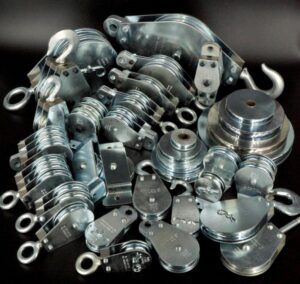
A pulley block (often just called a “block”) is a mechanical device that contains one or more rotating wheels called sheaves inside a frame.
A rope runs over these wheels to help:
When two or more pulley blocks are used together, they form a block and tackle system — which is just a fancy way of saying, “Let physics do some of the work.”
In simple terms:
A pulley block makes heavy things feel less heavy.
Not weightless. Just less insulting.
Main Components of a Pulley Block
Even though pulley blocks look simple, they have a few important parts:
The grooved wheel the rope runs through.
Without the groove, the rope would wander around like it forgot why it showed up.
The shaft that lets the sheave spin.
Small part. Big responsibility.
The metal frame holding everything together.
Think of them as the pulley’s skeleton.
Reduce friction so the sheave rotates smoothly.
Less friction = less effort = fewer complaints.
The connection point that attaches the pulley to a beam, structure, or load.
This is the “don’t let go” part.
How a Pulley Block Works
Pulley blocks operate using something called mechanical advantage.
Mechanical advantage means:
You use less force to lift something heavy.
But — and this is important — you must pull more rope.
Physics doesn’t do discounts.
If you cut the force in half, you pull twice as much rope.
If you reduce force to one quarter, you pull four times the rope.
You’re not escaping the work. You’re just spreading it out so your arms don’t panic.
Benefits and Advantages of Pulley Blocks
This is the big one.
Instead of lifting 400 pounds directly (which most of us will not be doing), a pulley system might allow you to pull with only 100 pounds of force.
Your muscles say thank you.
Pulley systems allow:
Which is very helpful when “dropping it” is not part of the plan.
Even a simple fixed pulley lets you pull down instead of lifting up.
Pulling down:
Gravity becomes your assistant instead of your rival.
Pulley blocks:
They are the quiet overachievers of the lifting world.
Many pulley blocks are small enough to fit in a toolbox.
Which means you can carry serious lifting capability without needing a truck full of equipment.
Real-World Examples of Pulley Block Use
Pulley blocks are everywhere — even if you don’t notice them. Here are a few examples about how pulley blocks can be used:
Construction Sites
Used to:
Because sometimes the elevator doesn’t exist yet.
Sailboats and Marine Use
Sailboats rely heavily on pulley blocks to:
Without pulley blocks, sailors would need arms like professional wrestlers.
Tree Work and Arborists
Tree workers use pulley blocks to:
Because gravity works very well on tree limbs.
Rescue Operations
Pulley systems are used in:
They allow teams to lift injured people smoothly and safely.
When strength alone isn’t enough, mechanical advantage steps in.
Workshops and Garages
Pulley blocks are often used for:
That moment when you say, “There’s no way I’m lifting that by hand” — pulley blocks solve it.
Gyms
Cable machines use pulley blocks to:
So yes — every time you do a cable workout, you’re using a pulley system.
You’re basically doing applied physics.
Elevators
Pulleys allow for the use of elevators:
Warehouses and Factories
Industrial hoists commonly use block and tackle systems.
Theater Stage Rigging
Used in:
Oil Drilling Rigs
Drilling rigs use pulley blocks for:.
Dockyards & Shipping
Used for:
Other ways in which pulley blocks are used include farm equipment and barn systems, home garage storage systems, and much more!
Advantages Over Lifting by Hand
Let’s compare:
Lifting directly:
Using a pulley block:
One approach relies on muscle.
The other relies on physics.
Physics usually wins.
Limitations (Because Nothing Is Perfect)
Pulley blocks are powerful — but not magical. They still:
Also, more pulleys = more rope to pull. So while your force decreases, your arm workout may increase. Fair trade.
Final Thoughts
Pulley blocks are one of the simplest yet most powerful mechanical tools ever invented.
They:
They don’t eliminate work. They just make it manageable.
And honestly, if you can let a wheel and some rope do part of the job — why wouldn’t you?
Block Division has been in business since 1960, giving us over 6 decades of experience in creating and manufacturing tough, high quality products. Over the past 65+ years, we’ve developed an intimate knowledge of the industry, understanding of what our customers need, and the expertise to deliver the best small pulley blocks, sheaves, and accessories on the market.
Check out Block Division’s online catalog, offering descriptions and more information about the variety of pulley blocks offered.