
Interested in block and tackle pulley maintenance & inspection tips? A well-maintained block and tackle pulley system doesn’t just last longer—it also operates more safely and efficiently. Whether your pulley system is used in industrial, marine, agricultural, construction, or recreational applications, performing routine inspections can help prevent unexpected equipment failures, reduce downtime, and lower replacement costs.
Regular maintenance allows you to identify worn or damaged components before they become a safety hazard. By taking just a few minutes to inspect your pulley blocks, sheaves, hooks, and related components, you can maximize the performance and service life of your equipment.
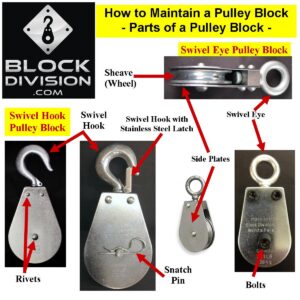
To help with your inspection, we’ve included a diagram (photo) that identifies the major parts of a pulley block. Use it as a reference while reviewing the maintenance recommendations below.
How Often Should You Inspect Your Pulley Block?
The frequency of inspection depends on how often your pulley system is used and the environment in which it operates.
As a general guideline:
Routine inspections help detect wear early and reduce the likelihood of costly repairs or unexpected failures.
Block and Tackle Pulley Maintenance Checklist
Rotate the sheave (wheel) several times by hand. It should turn freely and smoothly without sticking or grinding.
If the sheave does not rotate smoothly, apply an aerosol lubricant between the sheave and the side plates, then rotate it again.
If the sheave continues to bind after lubrication, it should be replaced—or the entire pulley block may need replacement.
How do you determine which option is best?
Examine the rivets or bolts that hold the pulley block together. Look for excessive wear, looseness, corrosion, or movement between the fasteners and the side plates.
Any noticeable deterioration may indicate that the pulley has reached the end of its service life.
If your pulley block includes a swivel or fixed hook, carefully inspect it for:
A damaged hook should never be straightened and reused. Replace the pulley immediately if hook damage is present.
If your pulley includes a snatch pin, verify that it seats securely and is properly retained with a bridge pin.
Refer to the accompanying diagram for proper installation.
Apply an aerosol lubricant to the sheave bushing on both sides of the sheave.
Proper lubrication reduces friction, minimizes wear, and helps the sheave rotate freely under load.
Visually examine the area between the side plates and the sheave for signs of:
These conditions can affect pulley performance and may require replacement.
Observe how the wire rope, cable, or fiber rope rides in the sheave groove.
If the rope jumps out of the groove and becomes lodged between the sheave and side plate, premature wear will occur on both components.
Continued operation under these conditions can permanently damage the pulley block.
Always ensure that the pulley block, sheave, and wire rope remain properly aligned during operation.
Improper alignment creates side loading, which can cause:
Correct alignment is one of the simplest ways to extend the life of your block and tackle system.
Signs It’s Time to Replace Your Pulley Block
Even with regular maintenance, pulley blocks eventually wear out. Replace the pulley if you notice any of the following:
Attempting to continue using a damaged pulley can reduce lifting efficiency and create unnecessary safety risks.
Safety Reminder
But wait! Here’s more block and tackle pulley maintenance & inspection tips! Before every lift, visually inspect your pulley block and all associated rigging components.
Never use a pulley block that shows signs of excessive wear, cracks, deformation, or other structural damage. Replacing worn components before failure occurs is far less costly than equipment damage, downtime, or personal injury.
Following a regular maintenance schedule not only extends the life of your equipment but also helps ensure safe and dependable operation every time your pulley system is used.
Replacement Parts Available from Block Division
If your inspection reveals worn or damaged components, don’t wait until they fail. Replacing a sheave or pulley block at the first sign of excessive wear helps maintain safe operation and keeps your equipment performing at its best.
Block Division offers replacement sheaves, pulley blocks, and accessories designed to meet the same high standards of quality and durability as our original products.
Built on Quality Since 1959
Since 1959, Block Division Inc. has specialized in designing and manufacturing durable, high-quality wire rope pulley products. Decades of engineering experience have enabled us to develop dependable pulley blocks, sheaves, and accessories that perform reliably in demanding applications.
Our commitment to quality control means every product is built with safety, durability, and long-term performance in mind. Customers across a wide range of industries rely on Block Division products because they know they are purchasing components engineered to withstand years of dependable service.
Whether you’re replacing a worn sheave, upgrading a pulley block, or looking for the right solution for a new application, Block Division offers hundreds of products backed by knowledgeable customer support and decades of manufacturing expertise.
To learn more about block and tackle pulley maintenance & inspection tips, call 800-433-0921 or visit www.BlockDivision.com to explore our complete line of pulley blocks, sheaves, accessories, and application resources.
Block Division has been in business since 1960, giving us over 6 decades of experience in creating and manufacturing tough, high quality products. Over the past 65+ years, we’ve developed an intimate knowledge of the industry, understanding of what our customers need, and the expertise to deliver the best small pulley blocks, sheaves, and accessories on the market.
https://www.blockdivision.com/