
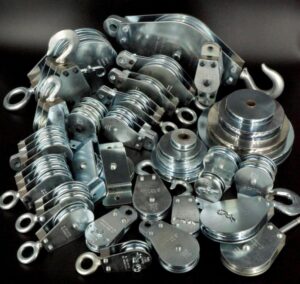
What is the difference between a single, double or triple sheave pulley block? Or, when do you need more wheels on your Pulley Block?
If you’ve ever looked at a pulley block and thought, “It’s just a wheel with a rope. How complicated can it be?” — you’re not alone.
At first glance, a pulley seems pretty simple. Run a rope over a wheel, pull on one end, and the load moves.
But add a second or third sheave, in a pulley block, and things start to get more interesting.
That’s because pulley blocks can do something very useful: they can make a heavy load feel much lighter by giving you mechanical advantage.
The key is understanding what mechanical advantage actually means.
First Things First: What Is Mechanical Advantage?
Mechanical advantage is simply a way of describing how much a pulley system reduces the amount of force you need to apply.
Let’s start with an example that doesn’t involve any complicated pulley terminology.
Imagine you have a 100-pound load sitting on the ground and you need to lift it.
If you try to lift it directly, you need to apply approximately 100 pounds of upward force.
Now imagine a pulley system allows you to lift that same 100-pound load by pulling with only 50 pounds of force.
That’s a 2:1 mechanical advantage.
The “2” means the system is giving you a two-to-one advantage:
100 lb load ÷ 2 = 50 lb of pulling force
Now imagine another pulley arrangement allows you to lift the same 100-pound load with only 25 pounds of force.
That’s a 4:1 mechanical advantage:
100 lb load ÷ 4 = 25 lb of pulling force
So when you see:
The larger the second number, the less pulling force you theoretically need.
That’s the basic idea behind mechanical advantage.
But There’s a Catch
If pulley systems could make heavy loads easier without any downside, we’d probably all have pulley systems in our garages.
The trade-off is that you have to pull more rope.
Think about it this way:
If you use a 2:1 system, you may only need half the force, but you have to pull about twice as much rope.
With a 4:1 system, you may only need one-quarter of the force, but you have to pull about four times as much rope.
With a 6:1 system, you may only need one-sixth of the force, but you have to pull about six times as much rope.
So you’re not getting something for nothing.
You’re trading:
More rope pulled → for → Less force required
That’s the basic bargain a pulley system makes with physics.
So What Is a Sheave?
Now that we understand mechanical advantage, let’s talk about the actual pulley.
The grooved wheel inside a pulley block is called a sheave.
The rope sits in the groove and rolls around the sheave.
A pulley block can contain:
But here’s an important point:
The number of sheaves does not automatically tell you the mechanical advantage.
The mechanical advantage depends on how the rope is routed through the pulley system and how many sections of rope are supporting the moving load.
That distinction is important.
A three-sheave block isn’t automatically a 3:1 system.
A two-sheave block isn’t automatically a 2:1 system.
The complete setup determines the mechanical advantage.
A single-sheave block has one sheave inside the housing.
It can be used in several differhttps://www.blockdivision.com/what-is-a-pulley-block/ent ways, but let’s start with the simplest.
A Fixed Single Sheave: 1:1
A fixed pulley is attached to something that doesn’t move, such as a beam or anchor point.
Its main job is to change the direction of the rope.
For example, imagine a 100-pound load hanging from a rope.
The rope runs over a fixed pulley above the load.
Instead of pulling upward to lift the load, you can pull downward.
That’s much more convenient.
But you’re not actually reducing the amount of force required.
You still need approximately 100 pounds of pulling force to lift a 100-pound load.
That’s called a 1:1 mechanical advantage.
In other words:
100 lb load ÷ 1 = 100 lb of force
The pulley changes the direction of your pull, but it doesn’t multiply your strength.
Why Use It?
A fixed pulley is useful when:
Think of it as the direction changer.
A Single Movable Sheave: 2:1
Now let’s change the arrangement.
Instead of attaching the pulley to the ceiling or another fixed point, we attach the pulley to the load itself.
Now the pulley moves upward with the load.
This changes everything.
The load is now being supported by two sections of rope.
Those two sections share the load.
That’s where the 2:1 mechanical advantage comes from.
Imagine the load weighs 200 pounds.
Instead of having to provide 200 pounds of pulling force, each supporting section of rope carries approximately half the load.
So:
200 lb ÷ 2 = 100 lb
You theoretically need about 100 pounds of pulling force.
But there’s a trade-off.
To raise the load 1 foot, you have to pull approximately 2 feet of rope.
So:
2:1 = half the force, twice the rope
That’s mechanical advantage in action.
Now we’re getting into more serious hauling territory.
A double-sheave block contains two sheaves in the same housing.
A double block is often paired with another pulley block to create a block-and-tackle system.
This is where you can create mechanical advantages such as 3:1 or 4:1, depending on how the rope is routed.
Let’s slow down and explain what those numbers actually mean.
What Does 3:1 Mechanical Advantage Mean?
Suppose you have a 300-pound load.
A properly configured 3:1 pulley system divides the load across three supporting rope sections.
Ideally:
300 lb ÷ 3 = 100 lb
So instead of pulling with 300 pounds of force, you would theoretically need about 100 pounds of pulling force.
That’s what 3:1 mechanical advantage means.
It does not mean the pulley weighs three times as much.
It does not mean there are three sheaves.
It simply means the pulley arrangement gives you a three-to-one force advantage.
And there is still a trade-off.
To raise the 300-pound load 1 foot, you would need to pull approximately 3 feet of rope.
So:
3:1 = one-third the force, three times the rope
What Does 4:1 Mechanical Advantage Mean?
Now let’s increase the mechanical advantage to 4:1.
Imagine you’re lifting a 400-pound load.
With a properly configured 4:1 system:
400 lb ÷ 4 = 100 lb
So you would theoretically need about 100 pounds of pulling force.
But to raise the load 1 foot, you’d need to pull approximately 4 feet of rope.
So:
4:1 = one-quarter the force, four times the rope
This is why a 4:1 system can be very useful when the load is too heavy for one person to move comfortably with a simpler setup.
You’re making the load feel lighter — but you’re pulling a lot more rope.
A triple-sheave block contains three sheaves inside one housing.
Triple blocks are commonly used with another block to create systems with even greater mechanical advantage.
Depending on the rope arrangement, systems can be configured for mechanical advantages such as 5:1 or 6:1.
Again, the number of sheaves doesn’t automatically determine the mechanical advantage.
It’s the complete rope arrangement that matters.
What Does 6:1 Mechanical Advantage Mean?
Let’s say you’re trying to lift a 600-pound load.
A properly configured 6:1 system provides six supporting rope sections.
Ideally:
600 lb ÷ 6 = 100 lb
So instead of pulling with 600 pounds of force, you’d theoretically need about 100 pounds of pulling force.
That’s a significant reduction.
But — you guessed it — there’s a trade-off.
To raise the load 1 foot, you would need to pull approximately 6 feet of rope.
So:
6:1 = one-sixth the force, six times the rope
Your arms are happier.
Your rope is working overtime.
Why Does the Rope Have to Move So Far?
This is one of the most important things to understand about mechanical advantage.
Imagine six sections of rope are supporting a moving load.
When you pull 6 feet of rope, each supporting section effectively contributes to lifting the load a small amount.
The result is that the load moves only about 1 foot.
That’s why increasing mechanical advantage reduces the force you need but increases the amount of rope you need to pull.
You are spreading the work across more rope.
Putting It All Together
Here’s a simple way to think about common mechanical advantage ratios:
| Mechanical
Advantage |
Load | Theoretical
Pulling Force |
Rope Pulled to
Raise Load 1 ft |
| 1:1 | 100 lb | 100 lb | 1 ft |
| 2:1 | 100 lb | 50 lb | 2 ft |
| 3:1 | 300 lb | 100 lb | 3 ft |
| 4:1 | 400 lb | 100 lb | 4 ft |
| 6:1 | 600 lb | 100 lb | 6 ft |
These are ideal theoretical values. Real pulley systems require more pulling force because of friction, rope bending, sheave efficiency, and other losses.
So What’s the Difference Between Single, Double, and Triple Sheaves?
Now that we understand mechanical advantage, the difference becomes much easier to understand.
A single sheave is the simplest option.
It can:
Think: Simple and straightforward.
A double sheave gives you more options for building a block-and-tackle system.
When properly configured, it can be used to create higher mechanical advantage systems such as 3:1 and 4:1.
That means you can move heavier loads with less pulling force.
Think: More lifting power without an enormous amount of equipment.
A triple sheave provides even more options for building high-mechanical-advantage systems.
Properly configured systems can provide mechanical advantages such as 5:1 and 6:1.
This can dramatically reduce the force required to move a heavy load.
But you’ll also need to pull significantly more rope.
Think: Heavy loads, serious mechanical advantage.
The Bigger the Mechanical Advantage, the More Rope You Pull
This is the relationship worth remembering:
Higher mechanical advantage → Less force required
But:
Higher mechanical advantage → More rope to pull
For example:
2:1
A 200 lb load requires approximately 100 lb of theoretical pulling force.
You pull 2 feet of rope to raise the load 1 foot.
4:1
A 400 lb load requires approximately 100 lb of theoretical pulling force.
You pull 4 feet of rope to raise the load 1 foot.
6:1
A 600 lb load requires approximately 100 lb of theoretical pulling force.
You pull 6 feet of rope to raise the load 1 foot.
The pulley isn’t eliminating the work.
It’s changing how you apply the work.
Why Not Just Use the Highest Mechanical Advantage Possible?
If 6:1 makes pulling easier than 2:1, why not always use 6:1?
Because more mechanical advantage isn’t always better.
A higher mechanical advantage can mean:
And if you’re moving a relatively light load, setting up a large block-and-tackle system may be unnecessary.
The goal isn’t to get the highest possible mechanical advantage.
The goal is to get the right mechanical advantage for the job.
Choosing the Right Pulley Setup
Choose a Single Sheave When:
Simple. Compact. Easy to understand.
Choose a Double Sheave When:
More power, without going overboard.
Choose a Triple Sheave When:
More mechanical advantage, more rope, more complexity.
One More Important Point: Real-World Mechanical Advantage
Everything we’ve calculated so far assumes an ideal pulley system with no friction.
Real pulley systems aren’t perfect.
Rope rubbing against sheaves, friction in bearings or bushings, rope stiffness, and other factors all reduce efficiency.
So if a theoretical calculation says you need 100 pounds of force, you may actually need more than 100 pounds to move the load.
That’s why mechanical advantage should be thought of as a force multiplier, not a guarantee of the exact amount of effort you’ll experience.
And, of course, the pulley block, rope, anchor points, and all other components need to be properly selected and rated for the application.
Summary:
The biggest thing to remember is that a pulley block isn’t simply about having more wheels.
It’s about how those wheels and the rope work together.
A single sheave can change the direction of a pull or provide basic mechanical advantage.
Adding sheaves and properly arranging the rope can create systems with 3:1, 4:1, 6:1, and higher mechanical advantages.
And now you know what those numbers actually mean:
3:1 means roughly one-third the pulling force.
4:1 means roughly one-quarter the pulling force.
6:1 means roughly one-sixth the pulling force.
But there’s always a trade-off:
The less force you use, the more rope you have to pull.
So the next time you look at a pulley block and think, “Why does this thing have so many wheels?”
You’ll know.
Those wheels aren’t just there for decoration.
They’re there to make a heavy load feel a whole lot lighter.
More wheels. Less pulling. More rope. That’s the trade-off.
Block Division has been in business since 1960, giving us over 6 decades of experience in creating and manufacturing tough, high quality products. Over the past 65+ years, we’ve developed an intimate knowledge of the industry, understanding of what our customers need, and the expertise to deliver the best small pulley blocks, sheaves, and accessories on the market.